Somewhere between Cursor writing an entire route handler from a sentence and Claude refactoring a component before the developer has fully thought through the API, the center of gravity in software development shifted. A lot of developers are no longer spending most of their energy on syntax, boilerplate, and repetitive implementation. They are spending it on instruction, direction, context, and iteration.
That shift has created a strange but useful phrase: tokenmaxxing.
The term sounds like internet satire, but it captures something real. Just like “maxxing” in other corners of the internet means optimizing every variable to squeeze out the best possible outcome, tokenmaxxing in software means learning how to spend prompts, context windows, and AI interactions as effectively as possible to get the strongest possible result. In practice, it means the developer who writes the best instruction often moves faster than the developer who writes the most code.
That sounds exciting. It also sounds slightly dystopian. And both reactions are valid.
This is not one of those posts pretending AI is either a magic replacement for engineers or an overhyped toy that serious developers can ignore. Both views are lazy. The more interesting truth is that AI has already changed the shape of engineering work, but it has not changed the need for judgment, systems thinking, product sense, and attention to detail. If anything, those things matter more now because code can be produced so cheaply.
The real question is not whether coding is becoming tokenmaxxing. The real question is: what parts of software work are becoming prompt-shaped, and what parts still require actual engineering taste?
The Shift From Writing to Directing
For a long time, software development was constrained by typing speed, recall, and familiarity with syntax. A lot of the day was spent translating intent into implementation line by line. Framework docs mattered. Boilerplate mattered. Remembering how to structure a form handler, a validation layer, an API client, or an auth flow mattered because the cost of forgetting was time.
AI coding tools changed that. Modern assistants can generate a first draft of all of those things almost instantly. They can scaffold a backend, write a React component, produce database queries, explain an error message, and suggest a refactor in the same session. The old bottleneck — getting from a blank file to working code — is much smaller than it used to be.
That means a growing amount of leverage now comes from a different skill: the ability to direct the model well. A developer who can provide the right context, constraints, edge cases, style expectations, and system boundaries can often get a much stronger output than a developer who just asks for “build me X.” Prompt quality, context quality, and evaluation quality are becoming part of engineering throughput.
In that sense, yes, coding really is becoming tokenmaxxing.
But only at the surface layer.
What Tokenmaxxing Actually Means
At the shallow level, tokenmaxxing sounds like “being good at prompting.” But that definition is too small. In software work, tokenmaxxing actually involves several overlapping abilities:
- Knowing how to describe a problem precisely.
- Supplying the model with enough context to avoid generic answers.
- Knowing which parts of a task should be delegated and which should stay manual.
- Comparing model outputs instead of trusting the first one.
- Recognizing when an answer is elegant but wrong.
- Iterating quickly without becoming mentally lazy.
In other words, tokenmaxxing is not just prompt-writing. It is interface design for machine reasoning.
That is why the best AI-assisted developers do not merely ask for code. They stage-manage the session. They chunk work. They request alternatives. They define constraints. They attach files. They specify failure modes. They ask the model to explain trade-offs, not just generate snippets. They use AI as a thought partner, a search layer, a boilerplate machine, a reviewer, and sometimes a junior engineer — but not as an unquestioned oracle.
This is also why prompt engineering tools are becoming a real category in production AI workflows. Teams now use tools for prompt testing, monitoring, evaluation, and versioning because prompting is no longer just a toy activity — it is becoming part of software delivery itself.
Why It Feels So Powerful
The reason tokenmaxxing feels revolutionary is simple: it attacks the most annoying parts of development first.
Most developers do not wake up excited to write repetitive CRUD handlers for the fifth time. They do not feel spiritually fulfilled by reassembling auth middleware, creating the same validation schema, or wiring standard UI states from scratch. A huge amount of software work has always been real but low-creativity labor.
AI is excellent at that layer. It is especially strong when the problem has:
- familiar patterns,
- lots of public examples,
- clear structure,
- low ambiguity,
- and limited business novelty.
That is why AI coding tools feel like magic on scaffolding, component drafts, test generation, documentation, migrations, simple scripts, API glue, and repetitive transformations. They compress the distance between intention and implementation. Productivity studies and broader analyses of coding assistants repeatedly find gains in throughput, reduced time spent searching, and faster drafting of common tasks, even while also warning about quality trade-offs.
This is the part many skeptics underestimate. There is no virtue in manually suffering through every repetitive implementation detail if a model can generate 80 percent of the first draft safely. Teams that refuse to use these tools are often just choosing slower iteration for no strategic reason.
So the productivity gain is real. The time savings are real. The workflow shift is real.
The problem is what people infer from that reality.
The Dangerous Leap: From Fast Output to False Understanding
Once a model can generate useful code quickly, it becomes very tempting to treat generated code as solved code. This is where tokenmaxxing becomes risky.
A model can give a convincing answer without possessing deep understanding of the actual system it is modifying. AI assistants often struggle with long dependency chains, vague requirements, custom internal tooling, fragmented context, and architecture decisions that depend on hidden constraints. They can output something that looks completely plausible while missing the reason a system was shaped a certain way in the first place.
This creates one of the biggest traps of the AI era: the gap between output quality and operator understanding.
A junior developer can now produce code that looks mid-level. A mid-level developer can ship code that looks senior. A founder can prototype like a startup team. But none of those outputs guarantee real comprehension. The code may run. The feature may demo well. The integration may even appear stable. And yet the person shipping it may not understand why it works, what assumptions it carries, or where it will fail under pressure.
That gap is where bugs, technical debt, and false confidence grow.
A Prompt Can Start the Work. It Cannot Finish the Product.
This is the hardest part to explain to non-technical people because AI makes software look easy.
A client can open ChatGPT, ask for a dashboard, and get back a polished-looking interface. A founder can prompt an LLM for a product plan and suddenly feel like execution is mostly solved. Someone outside engineering sees these first drafts and concludes that building software has become cheap, instant, and mostly automatic.
But anyone who has actually shipped products knows how misleading that is.
A real product is not the first 70 percent. It is the final 30 percent that takes the most maturity:
- the auth edge case that only appears on refresh,
- the background job that sometimes duplicates work,
- the upload flow that breaks for certain file types,
- the billing state that falls out of sync,
- the race condition that only appears under concurrency,
- the brittle data shape from a third-party API,
- the infrastructure decision that looks small and becomes expensive later,
- the copy mismatch that tanks conversion,
- the layout bug that appears only on one weird viewport,
- the permission rule that leaks data in an unexpected state.
A prompt can get you a route handler. It cannot absorb the product context needed to make those hundreds of decisions well.
That is why this topic feels personal to a lot of builders. It is one thing to watch AI speed up programming. It is another to watch people assume that speed cancels out effort.
Recently, I spent around one and a half months building a project for a client. Then they suddenly decided not to continue with it and refused to pay the remaining amount. I was fortunate to have phase-wise payment in place, so at least part of the work was protected. But the experience reinforced something I already believed: software is not expensive because typing is hard. It is expensive because judgment is expensive. Iteration is expensive. Attention to detail is expensive. The invisible decisions are expensive.
That is the part AI demos hide.

Where Tokenmaxxing Works Extremely Well
It is important not to overcorrect. Tokenmaxxing is not fake work. It is not just hype. It is genuinely useful, and in some workflows it is becoming a superpower.
Here is where it shines:
1. Scaffolding and first drafts
Starting from zero is slow. Starting from a model-generated draft is much faster. UI sections, endpoints, schema definitions, migrations, validation layers, internal tooling, scripts, and test cases are often excellent candidates for AI-assisted drafting.
2. Translation across layers
Need to convert a rough idea into SQL, then into TypeScript types, then into an API contract, then into a React form? Models are remarkably good at moving between representations quickly. They act like a bridge between product intent and implementation detail.
3. Research compression
Instead of opening ten tabs to compare similar patterns, developers can ask the model to summarize trade-offs, propose alternatives, and provide a starting path. This does not replace verification, but it dramatically reduces search overhead.
4. Repetitive but important code
There is no badge of honor in rewriting the same form validation logic or route boilerplate for the twentieth time. AI reduces drudgery, which means developers can spend more attention on product-specific problems.
5. Debugging with context
AI is often useful when the developer already understands the system and wants help narrowing possibilities. In this mode, the model acts more like a brainstorming layer than a magic fixer.
6. Accelerated learning
For motivated developers, AI can be an unusually effective tutor. Asking for explanations, comparisons, examples, and refactors can shorten the learning loop, especially when exploring a new framework, language, or design pattern.
If this sounds like a lot, it is. That is exactly why ignoring AI is not a serious strategy anymore.
Where Tokenmaxxing Fails Hard
The limits matter just as much as the strengths. And the more confidently people talk about AI-generated software, the more important those limits become.
1. Architecture under real constraints
Architecture is not just choosing trendy patterns. It is making trade-offs under actual business, infrastructure, team, and timeline constraints. Models rarely have enough context to make those decisions correctly.
2. Ambiguous product work
A product requirement is often unclear until someone starts building. Human developers interpret vague requirements using judgment, past experience, and product sense. Models tend to fill ambiguity with generic assumptions.
3. Novel or proprietary systems
AI tends to perform best where patterns are well-documented. It struggles more when the codebase uses internal abstractions, domain-specific workflows, or unusual business logic.
4. Deep debugging
Runtime issues that span services, state boundaries, infra layers, and timing problems remain difficult for models to reason about consistently.
5. Long-term maintainability
Generated code may be functional while quietly adding complexity, redundancy, poor abstractions, or technical debt. Some broader analyses of coding assistants note that increased throughput can come with higher defect rates or lower code quality if review standards do not keep up.
6. Thinking itself
This is the uncomfortable one. AI can become a substitute for struggling productively with a problem. Sometimes the hard part of engineering is not typing the code — it is thinking clearly enough to know what code should exist. If every uncertainty is instantly offloaded to a model, that mental muscle weakens.
That is the real danger beneath the memes.
The Hidden Cost: Skill Atrophy
The biggest long-term risk is not that AI writes code badly. The biggest risk is that humans stop learning how to reason deeply because a model is always nearby with a plausible answer.
This is especially important for early-career developers.
A beginner can now ship more than ever before. That is good. But a beginner can also accidentally construct an entire workflow built on borrowed intelligence. They can become effective at assembling outputs without becoming effective at understanding systems. The illusion of competence gets stronger because the artifacts look real.
This is not hypothetical. Multiple analyses of LLM-assisted development point to concerns around cognitive offloading, reduced collaboration, inconsistent quality effects, and the possibility that throughput gains can hide weaker engineering foundations.
To be clear, cognitive offloading is not always bad. Every tool offloads something. Frameworks offload infrastructure complexity. Languages offload memory management. Libraries offload implementation detail. That is normal.
The danger appears when offloading skips the formation of core mental models:
- how state flows through a system,
- how data changes under failure,
- how race conditions emerge,
- why some abstractions age badly,
- what makes a schema future-proof,
- where performance bottlenecks hide,
- when simplicity is worth more than cleverness.
These are not trivia facts. They are judgment structures. And without them, tokenmaxxing turns into dependency.
The New Best Developer Is Not the One Who Types the Least
There is a lazy metric creeping into the discourse: if AI wrote most of the code, the developer is more efficient. That is not always true.
The better metric is this: how well can the developer evaluate, direct, and improve what the model produces?
The strongest developers in the AI era are not merely “non-coders with good prompts” and they are not stubborn purists who refuse assistance. They are people who combine three things:
- Clear product thinking — they know what problem is actually being solved.
- Strong engineering judgment — they know what good implementation looks like.
- High AI fluency — they know how to extract value from models without outsourcing responsibility.
That combination is powerful because it compounds. A developer with good judgment can use AI to test more options, ship faster, and spend more time on hard decisions. A developer without good judgment may also ship faster, but they often just ship confusion sooner.
This is why the “AI will replace developers” conversation is still too shallow. More accurately, AI raises the premium on developers who can reason. It compresses commodity implementation and expands the value of evaluation, architecture, prioritization, integration, and taste.
The floor dropped. The ceiling did not.
Tokenmaxxing Inside Teams and Companies
There is another strange angle to all of this: token usage itself is starting to become a cultural signal. Reports and commentary about “tokenmaxxing” in companies describe environments where developers are incentivized to maximize AI usage, not just outcomes, because being visibly AI-native becomes its own performance signal.
That creates a subtle distortion.
Once token consumption becomes a proxy for productivity, teams can start optimizing for visible AI activity instead of real engineering quality. More prompts, more agents, more generated code, more internal screenshots — all of it can look like velocity even when the underlying work is not improving proportionally.
This is not a reason to reject AI. It is a reminder that every tool can become theater if the metric is wrong.
A healthy engineering culture should reward:
- shipped value,
- code quality,
- system clarity,
- maintainability,
- speed with understanding,
- and better decisions.
Not just token burn.
A Better Mental Model for AI-Assisted Coding
The most useful mental model I have found is this: an LLM is like a very fast junior developer with enormous recall and inconsistent judgment.
That framing helps because it immediately corrects two extremes.
First, it stops you from dismissing the tool. A great junior developer can save a huge amount of time. They can write drafts, surface patterns, document code, explore options, and move quickly.
Second, it stops you from romanticizing the tool. A junior developer still needs guidance. They still need review. They still need someone who understands the system to validate what they produced.
This model also clarifies what your job becomes. Increasingly, the role of a good engineer is not just implementation. It is:
- framing the problem correctly,
- setting constraints,
- reviewing outputs,
- making trade-offs,
- orchestrating systems,
- and protecting product quality.
That is why AI does not eliminate engineering. It changes where engineering effort concentrates.
What This Means for Developers Early in Their Career
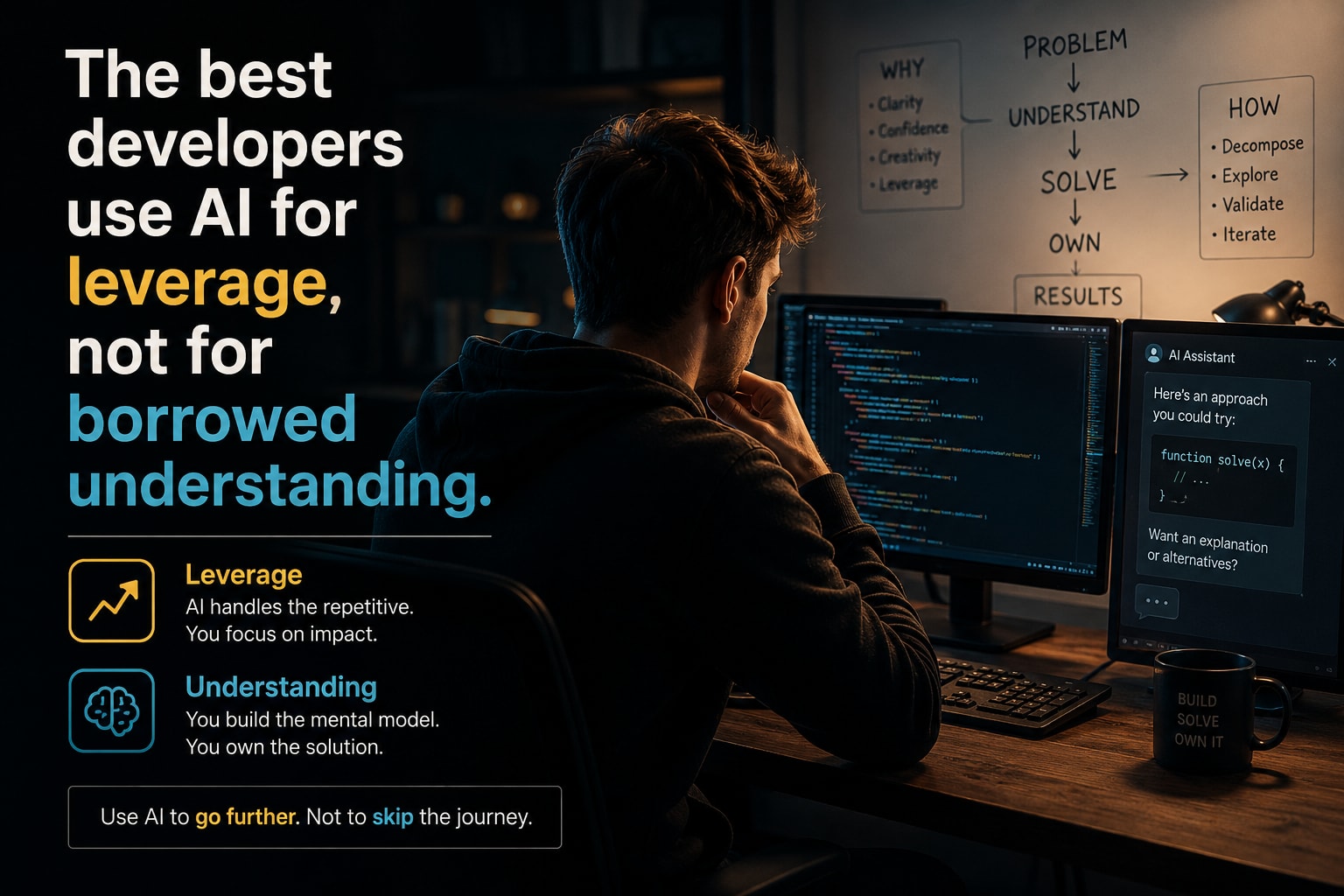
If you are just starting out, the goal is not to avoid AI. That would be like trying to become a modern designer without using Figma. The goal is to use AI in a way that strengthens your understanding instead of replacing it.
A few practical rules help:
Build some things without AI first
Not forever. Just enough to understand what the model is doing for you.
Ask “why” more than “what”
When the model gives you code, ask why it chose that pattern, what alternatives exist, and where it might fail.
Rewrite generated code in your own words
If you cannot explain the code, you do not really own it.
Review generated code aggressively
Do not treat clean formatting as proof of correctness.
Learn debugging manually
When something breaks, resist the urge to immediately paste the entire problem into a model. Spend a few minutes reasoning first. That discomfort is where the learning happens.
Use AI to compress repetition, not skip fundamentals
The best use of these tools is to remove drudgery, not remove understanding.
Early-career developers who do this will be much stronger than both extremes: stronger than the purists who refuse AI, and stronger than the people who outsource all thinking to it.
What This Means for Clients, Founders, and Stakeholders
This conversation is not just for engineers. Clients and founders need a better model too.
Yes, AI reduces some development costs. Yes, it speeds up prototyping. Yes, it makes small teams more capable. Those things are all real.
But no, it does not eliminate the need to pay for thoughtful engineering work.
If anything, the market may become more confusing because rough outputs are so easy to generate. The first impression of a product will become cheaper. The polished, reliable, maintainable version will still depend on real product and engineering judgment.
That means stakeholders should update their expectations in a more nuanced way:
- expect faster first drafts,
- expect quicker iteration loops,
- expect smaller teams to do more,
- but do not expect complexity to disappear.
The software may arrive faster, but the hard parts of product-building have not vanished. They have simply become less visible to people watching from outside.
So, Is Coding Becoming Tokenmaxxing?
Yes — but only if the phrase is used carefully.
Coding is becoming tokenmaxxing in the sense that the interface of development is changing. More of the work now begins as instruction. More leverage comes from describing, constraining, and evaluating than from manually typing every implementation detail.
But coding is not becoming tokenmaxxing if the phrase implies that software engineering is collapsing into prompt-writing alone. That view confuses generation with understanding.
Prompting is becoming part of engineering. It is not replacing engineering.
The developers who will thrive over the next few years are not the ones who type the most code, nor the ones who type the least. They are the ones who know what should be built, know how to direct AI to accelerate that work, and know how to take over when the model stops being useful.
That is the real skill stack now.
And maybe that is the most honest conclusion of all: the future does not belong to the best coders or the best prompters in isolation. It belongs to the builders who can do both — and who know the difference between fast output and good judgment.
Because in the end, a prompt can draft the code.
But only an engineer can decide whether the product is actually right.